Are you a homeowner looking for robust protection for your car? A rancher needing a reliable barn for your livestock and equipment? A business owner seeking a durable, expansive structure for storage or operations? Or simply a property owner needing a versatile steel building solution? If so, you’re likely exploring the world of pre-engineered metal buildings. These structures, often referred to as steel carports, garages, barns, RV covers, and more, offer a compelling blend of strength, longevity, and customization.
Navigating the landscape of steel building options can feel complex, with terms like wind load, snow load, and certifications often appearing. This guide cuts through the jargon, providing you with essential, trustworthy information to make informed decisions. We’ll cover the critical factors you need to consider, from engineering specifications to pricing and local regulations, ensuring you invest wisely in a steel building that meets your specific needs for years to come.
At its heart, a steel building is a prefabricated structure engineered and manufactured off-site, then delivered for on-site assembly. This process offers significant advantages over traditional construction. Instead of site-specific framing and material procurement, you’re dealing with precision-cut components designed to fit together seamlessly. This method is particularly well-suited for agricultural buildings, commercial storage, residential garages, and specialized structures like RV and boat covers.
Durable Materials, Engineered for Performance
The primary material, of course, is structural steel. This isn’t your average construction-grade steel; it’s high-strength, galvanized steel designed to withstand the elements. The galvanization process, a coating of zinc, provides crucial corrosion resistance, protecting your investment from rust and decay, especially important in areas with high humidity or coastal proximity. The engineering of these buildings is paramount, ensuring they can handle significant environmental stresses.
Pre-Engineered Systems: Efficiency and Precision
The “pre-engineered” aspect is key. Manufacturers utilize sophisticated software to design each component to exact specifications. This includes everything from the primary framing members (like rigid frames or clear-span trusses) to secondary framing (purlins and girts) and the exterior sheeting. This precision ensures a consistent, high-quality product and streamlines the erection process, often leading to faster project completion times compared to conventional construction.
For property owners considering the benefits of steel buildings, understanding the installation process is crucial. A related article that provides valuable insights is titled “Custom Metal Carports Near Clearwater County, Idaho,” which discusses various aspects of metal carport installation and customization options. This resource can help property owners make informed decisions about their steel building projects. You can read more about it here: Custom Metal Carports Near Clearwater County, Idaho.
Critical Engineering Factors: Beyond the Basics
When you’re investing in a steel building, understanding its engineering is non-negotiable. This is where the true value and longevity of your structure are determined. We’re not just talking about a metal box; we’re talking about a meticulously designed system built to perform under specific environmental pressures.
Wind Load Resistance: Standing Strong Against Gales
One of the most crucial engineering considerations is wind load. This refers to the amount of force wind exerts on a building’s surfaces. Buildings are engineered to withstand specific wind speeds, often measured in miles per hour (mph). The required wind load resistance for your steel building will depend heavily on your geographical location. Coastal areas, plains with frequent storms, or regions prone to hurricanes will necessitate higher wind load ratings.
Why it matters for you: A building not engineered for your local wind conditions could suffer severe damage or even collapse during a storm, leading to significant repair costs and potential safety hazards. Always verify the wind load rating with your supplier and ensure it meets or exceeds local building codes. For instance, a coastal homeowner in Florida will need a significantly higher wind load rating than a homeowner in landlocked Kansas.
Snow Load Capacity: Bearing the Winter Burden
Similarly, snow load is a critical factor for properties in colder climates. This considers the weight of accumulated snow on the roof of your structure. Like wind load, snow load requirements vary dramatically by region. Areas known for heavy snowfall will demand a higher snow load capacity. The pitch of the roof also plays a role; steeper roofs shed snow more effectively, reducing the load.
Practical example: If you live in a mountainous region or a city with a history of heavy winter snows, purchasing a standard RV cover without sufficient snow load capacity could result in a collapsed roof after a severe blizzard. Ensure the building is rated for your area’s typical maximum snow accumulation. A 30 psf (pounds per square foot) snow load rating is common in moderate climates, but areas with extreme snowfall might require 60 psf or more.
Certifications and Building Codes: Ensuring Compliance and Quality
Building codes are established by local governments to ensure the safety, health, and general welfare of the public. Pre-engineered metal building suppliers often offer different levels of certification to meet these codes.
- AWS Certified: This certification signifies that the welding performed on the building components meets the American Welding Society’s standards.
- Stamped Engineered Drawings: This is a critical document. It means a licensed professional engineer in your state has reviewed and approved the building’s design for your specific location, taking into account local wind and snow loads, seismic activity, and other relevant factors. These drawings are usually required by local building departments for permit approval.
Buyer guidance: Always ask for stamped engineered drawings for your specific location. This assures you the building is designed for your area’s conditions and will pass local inspections. Skipping this step can lead to significant headaches with building permits and, more importantly, compromise the safety and structural integrity of your building.
Customization and Practical Applications: Steel Buildings in Action
The versatility of steel buildings is one of their strongest selling points. They aren’t limited to a single purpose. With intelligent design and a range of options, you can tailor them to almost any need.
Metal Garages and Carports: Protecting Your Vehicles
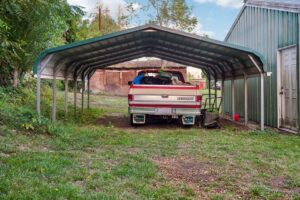
For homeowners, a primary application is vehicle protection. Metal garages offer fully enclosed, secure spaces for cars, trucks, motorcycles, and other valuable assets. They provide superior protection against the elements – sun, rain, hail, snow, and even pests – compared to open parking. Metal carports, on the other hand, offer a more budget-friendly, open-air solution for shielding vehicles from direct sun and light precipitation, ideal for RVs, boats, or extra vehicle parking.
Sizing considerations: When choosing a garage or carport, think about your current and future needs. Do you need space for two cars? Will you be storing lawn equipment alongside your vehicle? Consider wider bays and deeper structures for added flexibility. A standard 1-car garage is typically 12 ft wide by 20 ft long, while a 2-car garage often starts at 20 ft wide by 20 ft long.
Barns and Agricultural Buildings: Supporting Your Operations
Ranchers and farmers find steel buildings indispensable for their operations. Prefabricated metal barns offer durable, cost-effective solutions for housing livestock, storing hay, grain, and equipment, or serving as workshops. The clear-span designs often offered in steel buildings eliminate the need for interior support columns, maximizing usable space, which is invaluable for large equipment or animal pens.
Pros of metal barns:
- Durability: Highly resistant to rot, fire, and pests that can plague traditional wooden barns.
- Low Maintenance: Minimal upkeep required beyond occasional cleaning.
- Fast Erection: Can be erected significantly faster than conventionally built barns.
- Cost-Effective: Often more economical, especially for larger structures.
Commercial and Industrial Steel Buildings: Versatile Storage and Operations
Businesses across various sectors utilize steel buildings for warehouses, workshops, retail spaces, manufacturing facilities, and more. Their scalability, durability, and customizable features make them an excellent choice for growing enterprises. The ability to span large areas without interior columns is a significant advantage for businesses requiring open floor plans for intricate machinery or extensive inventory management.
Pricing factors: For commercial applications, factors like building height, insulation requirements, specific door sizes, and custom aesthetic features will influence the final price.
Sure, here is the sentence with the clickable link:
Watch our Expert Metal Carport and Steel Building Installation Videos on YouTube.
Key Considerations for Your Steel Building Purchase
Making the right choice involves more than just selecting a size and color. Several critical factors will influence your decision and the long-term satisfaction with your investment.
Sizing Your Steel Building: Precision Matters
Accurate sizing is paramount to ensure your building serves its intended purpose without being overly expensive or insufficient. Measure the dimensions of what you intend to store or house. For vehicles, consider not just the length and width but also the height required, especially for larger trucks, RVs, or boats with antennae.
Practical advice: Always add a little extra space. It’s far easier to account for a few extra feet upfront than to wish you had more room later. Think about the maneuvering space needed to enter and exit, especially for enclosed garages. Many suppliers offer online tools that can help you visualize and configure different sizes.
Pricing Factors: What Influences the Cost?
The price of a steel building is not a single number but a complex equation. Understanding these factors will help you budget effectively and compare quotes accurately.
- Size and Height: Larger and taller buildings naturally require more materials and engineering.
- Gauge of Steel: The thickness of the steel used for framing and sheeting. Heavier gauge steel (lower number) is stronger and more expensive.
- Wind and Snow Load Ratings: Higher ratings require more robust engineering and materials, increasing cost.
- Certification and Engineering: Stamped engineered drawings and specific certifications add to the price.
- Foundation Type: The cost of a concrete foundation will be separate from the building itself but a necessary component.
- Door and Window Options: The number, size, and type of doors and windows will impact the price.
- Insulation: Adding insulation for climate control significantly increases cost but provides long-term energy savings.
- Color and Finish: While less impactful than engineering factors, premium colors or coatings can add a small premium.
- Delivery and Installation: These costs can vary significantly based on your location and the complexity of the installation.
Installation: DIY vs. Professional Assembly
Many metal buildings are designed for relatively straightforward assembly, and some property owners opt for DIY installation to save costs. However, this requires a good understanding of construction, the right tools, and adequate labor.
When to hire professionals:
- Complex Designs: Buildings with complex rooflines or unique features.
- Large Structures: Larger barns, garages, or commercial buildings.
- Code Requirements: Local building codes might mandate professional installation for certain structures.
- Lack of Experience/Tools: If you don’t have the necessary skills or equipment, professional installation is a safer and often more efficient choice.
Buyer guidance: Always get clear installation quotes from reputable installers. Understand what is included in the price – site preparation, foundation work, assembly, and cleanup.
If you’re considering investing in a steel building, it’s essential to be well-informed about the various aspects of ownership and maintenance. A related article that provides valuable insights is one that discusses the benefits of custom metal carports, which can be particularly useful for property owners looking to enhance their outdoor spaces. You can read more about it in this informative piece that highlights the advantages of these structures and how they can complement your steel building investment.
Local Relevance: Navigating Area-Specific Needs
| Property Owners | Steel Buildings |
|---|---|
| 1 | Cost-effective |
| 2 | Durable and long-lasting |
| 3 | Customizable designs |
| 4 | Quick construction time |
| 5 | Low maintenance |
| 6 | Energy efficient |
| 7 | Environmentally friendly |
Your location dictates many of the requirements for your steel building. Understanding these local nuances is crucial for making the right choice.
Navigating Local Building Codes and Permits
Every municipality has its own set of building codes and permit requirements. These are often based on state and international building codes but can have local amendments.
What you need to know:
- Zoning Laws: Check your local zoning ordinances to ensure the type of building you want is permitted on your property and what size/height restrictions apply.
- Permit Process: Contact your local building department early in the process to understand the permit application, required documentation (like engineered drawings), and inspection schedule.
- Foundation Requirements: Some local codes have specific requirements for foundation thickness and specifications.
- Setbacks: Rules dictating how far a building must be from property lines.
Local example: A homeowner in a rural area with relaxed regulations might have fewer hurdles than someone in a densely populated suburban area with strict HOA covenants and municipal building codes. Always engage with your local building department before ordering your steel building.
Environmental Factors: Coastal, Desert, and Mountainous Regions
The extreme conditions in certain regions require specialized engineering for steel buildings.
- Coastal Areas: Require higher wind load ratings and robust corrosion-resistant coatings due to salt spray.
- Desert Regions: Need excellent UV protection, potentially lighter colors to reflect heat, and good ventilation to combat extreme temperatures.
- Mountainous Areas: Demand high snow load capacities for roofs and robust wind load ratings due to mountain winds. Seismic considerations might also be relevant in some mountainous zones.
If you’re considering investing in a steel building, it’s essential to understand the various aspects that come with it. A related article that provides valuable insights is about the advantages of vertical roof metal carports, which can be particularly beneficial for property owners in areas like Lincoln County, Montana. You can read more about this topic by visiting this link. Understanding these features can help you make an informed decision when selecting the right structure for your needs.
Frequently Asked Questions About Steel Buildings
We’ve compiled some common questions homeowners, ranch owners, and business owners ask:
Q: Are steel buildings more expensive than traditional construction?
A: Generally, pre-engineered steel buildings can be more cost-effective, especially for larger structures or when considering the total project cost including labor and time. They offer a high durability-to-cost ratio.
Q: How long do steel buildings last?
A: With proper maintenance and protection from excessive corrosion, a well-engineered steel building can last 50 years or more. The structural steel itself is incredibly durable, and the galvanization provides excellent long-term protection.
Q: Can I add features like insulation or windows later?
A: Yes, most steel buildings are designed with future modifications in mind. Insulation can be added during construction or later, and windows and doors can be incorporated into the wall panels.
Q: What kind of foundation do steel buildings require?
A: The most common foundation is a reinforced concrete slab. However, depending on the building’s size, intended use, and local codes, other foundation types like concrete piers or a gravel base might be acceptable. This is a critical discussion point with your supplier and local building department.
Q: How much maintenance is involved with a steel building?
A: Maintenance is minimal. Regular cleaning to remove dirt and debris is recommended. Flushing the exterior with water can help prevent salt buildup in coastal areas. Periodic checks for any signs of rust or damage to coatings are advisable.
Comparison: Steel Buildings vs. Other Structures
Steel Buildings vs. Wood Structures:
- Pros of Steel: Superior strength-to-weight ratio, resistance to rot, pests, fire, and warping. Predictable costs and faster erection.
- Cons of Steel: Can be susceptible to rust if coating is damaged. Can be perceived as less aesthetically “traditional” by some.
- Pros of Wood: Familiar construction methods, can be aesthetically pleasing with various finishes.
- Cons of Wood: Susceptible to rot, insects, and fire. Requires more ongoing maintenance. Higher labor costs for large structures.
Steel Buildings vs. Brick/Masonry:
- Pros of Steel: Significantly faster erection time, more cost-effective for large clear-span structures.
- Cons of Steel: Less mass for thermal regulation compared to thick masonry.
- Pros of Brick/Masonry: Excellent thermal mass, very durable and low maintenance.
- Cons of Brick/Masonry: Much higher upfront cost, significantly longer construction time, less flexibility for large spans without extensive engineering.
Conclusion: Steel buildings represent a smart, modern solution for property owners seeking durable, versatile, and cost-effective structures. By understanding the critical engineering factors like wind and snow load, prioritizing certifications and local code compliance, and carefully considering sizing and installation, you can confidently invest in a steel building that will serve your needs reliably for decades to come. Always work with reputable suppliers who can provide the necessary documentation and support to ensure your project is a success.
FAQs
What are the benefits of using steel buildings for property owners?
Steel buildings offer several benefits for property owners, including durability, cost-effectiveness, and versatility. They are resistant to fire, termites, and mold, and can be customized to fit various architectural styles and designs.
What are the common applications for steel buildings?
Steel buildings are commonly used for a variety of applications, including warehouses, industrial facilities, agricultural buildings, commercial spaces, and even residential homes. They are also popular for use as garages, workshops, and storage facilities.
How do steel buildings compare to traditional construction methods?
Steel buildings offer several advantages over traditional construction methods, including faster construction times, lower maintenance costs, and greater design flexibility. They are also more environmentally friendly, as steel is a recyclable material.
What factors should property owners consider when choosing a steel building?
When choosing a steel building, property owners should consider factors such as the building’s intended use, size, location, local building codes and regulations, as well as their budget and desired customization options. It’s also important to work with a reputable and experienced steel building manufacturer or contractor.
What maintenance is required for steel buildings?
Steel buildings require minimal maintenance compared to traditional construction materials. Regular inspections for rust, corrosion, and damage are recommended, as well as keeping the building clean and free of debris. Additionally, applying a protective coating can help extend the lifespan of the steel structure.